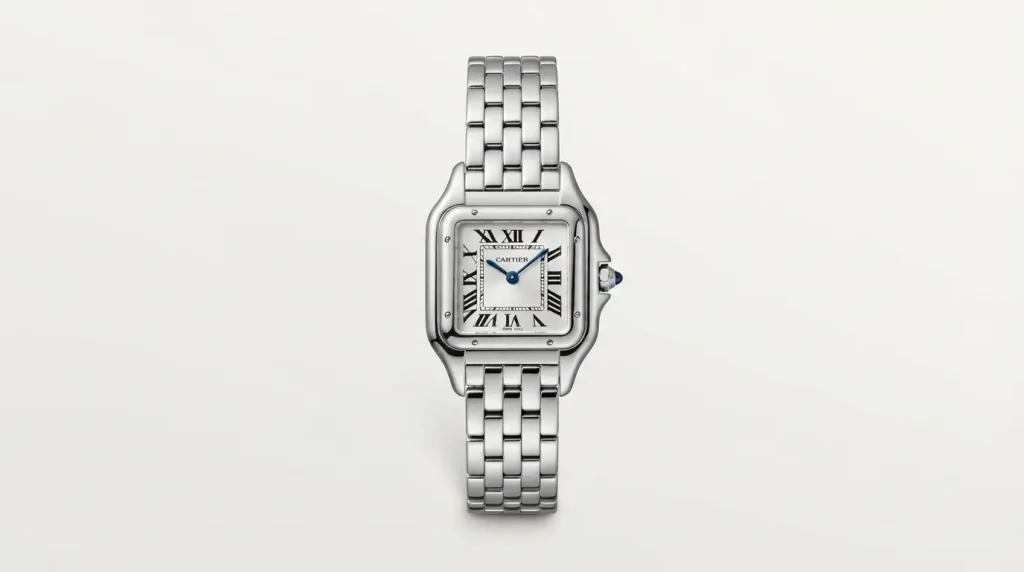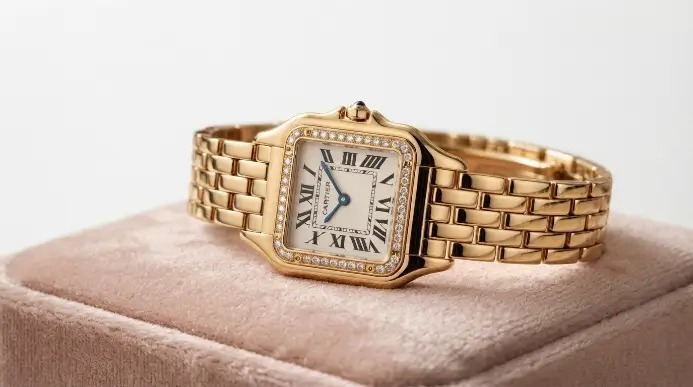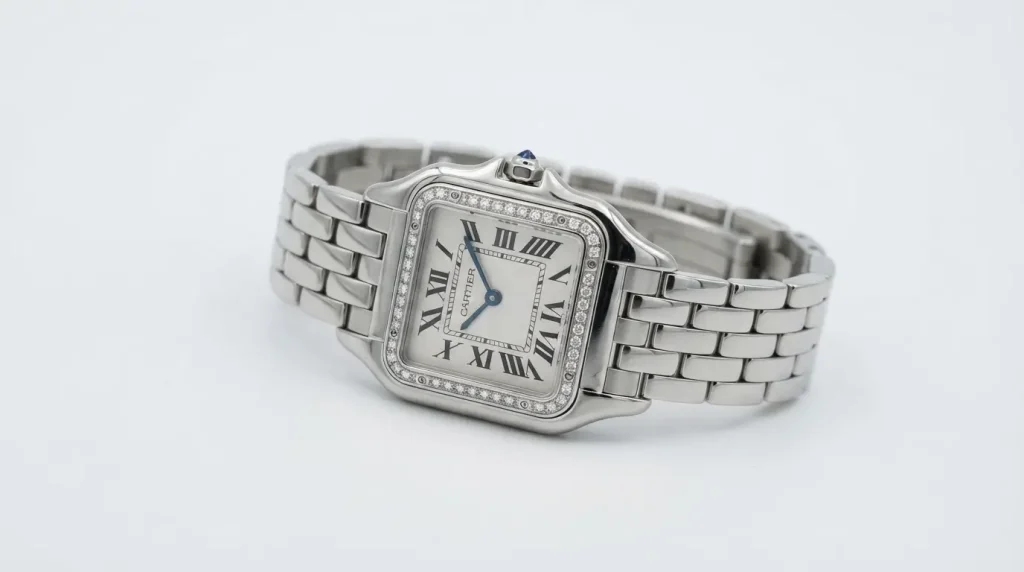

The Must de Cartier 21 watch is one of Cartier’s more distinctive vintage designs. Unlike the rectangular Tank or the square Santos, the Must 21 uses a rounded case and a bold bezel marked with Roman numerals. It was created during Cartier’s push to bring its design language to a wider audience, and today it has developed a following among collectors who appreciate unusual vintage Cartier watches.
Several references were produced in different sizes, dial layouts, bracelets and quartz movements, so identifying the exact reference is important when researching one.
What Is the Must de Cartier 21 Watch?
The Must de Cartier 21 is a vintage Cartier watch from the broader Must de Cartier era.The model is usually recognized by its round case, prominent bezel, Roman-numeral design and blue cabochon-style crown. Most examples are associated with quartz movements, although specifications vary between references and production periods.
The name can also create confusion because “21 Must,” “Cartier 21,” “Must 21” and “Must de Cartier 21” are all used to describe watches from this family.
The History Behind Cartier Must 21
The Must de Cartier collection was part of Cartier’s effort to make its recognizable design language available beyond its traditional precious-metal offerings.The Must concept appeared during a period when Cartier was experimenting with steel, vermeil, gold-plated elements, colorful designs and quartz movements. The approach helped Cartier connect its classic identity with a younger and broader audience.
The Must 21 followed this direction with a sportier, more contemporary shape. Collector sources generally place the model’s introduction in the mid-1980s, with references such as the 9010 and 9011 appearing in vintage Cartier records.
Why Is It Called Cartier 21?
The “21” in the name is one of the more interesting parts of the model’s history.There is no universally confirmed explanation that settles the meaning. One commonly discussed theory connects the number with 21 Rue de la Paix, the famous Paris address associated with Cartier. Other interpretations connect the number with the idea of a new generation or the modern character of the collection.
Because the explanation is not firmly established, it is better to treat these as historical theories rather than a confirmed fact.
The Distinctive Round Case
The round case is what immediately separates the Must 21 from Cartier’s better-known rectangular and square designs.The bezel is visually prominent and can feature Roman numerals or gold-toned detailing around the outside. This gives the watch a sporty appearance while retaining the traditional Cartier emphasis on Roman numerals and refined finishing.
Vintage examples appear in different sizes. The Vintage Cartier Codex lists 24mm, 30mm and 35mm configurations among different Must 21 references, showing why the phrase “Cartier Must 21” alone is not enough to determine the exact dimensions.
Must 21 Dial Design
The dial design depends on the reference.Some Must 21 watches have relatively simple hour and minute displays, while other versions include seconds or a date. Dial colors and numeral treatments also vary.
The clean layout is part of the model’s appeal. The bezel can carry much of the visual personality, allowing the dial itself to remain relatively restrained.A blue cabochon-style crown is another recognizable Cartier detail found across many examples.
Quartz Movement and Everyday Use
Most vintage Must 21 examples are associated with quartz movements.The Vintage Cartier Codex records Cartier quartz calibres including the 081, 087 and 090 across different references. For example, the 30mm 9010 is listed with Cartier 081/090 quartz movements, while the 35mm 9011 uses Cartier 087 quartz.
Quartz was an important part of the Must concept because it offered convenient everyday timekeeping without the winding routine of a traditional mechanical watch.This also means that movement identification should be based on the exact reference rather than assuming every Must 21 uses the same calibre.
Must de Cartier 21 Reference Numbers
Understanding reference numbers is one of the most useful parts of researching a vintage Cartier 21.The 9010 appears in both 30mm and 24mm configurations in the Vintage Cartier Codex. The 9011 is listed as a 35mm model with date, hours, minutes and seconds. Later 1330 and 1340 references are also documented in 30mm and 24mm sizes.This variation explains why two watches both called “Must de Cartier 21” can look noticeably different.
Must 21 Reference 9010
The 9010 is documented in both larger and smaller configurations.The 30mm version is listed with a stainless-steel case, sapphire crystal, quartz movement and approximately 30 metres of water resistance. It was available with leather or a “grain de riz” style bracelet.
Must 21 Reference 9011
The 9011 is a larger 35mm configuration.Unlike simpler hour-and-minute versions, this reference is documented with date, hours, minutes and seconds, powered by a Cartier 087 quartz movement.
Must 21 References 1330 and 1340
The 1330 and 1340 represent smaller configurations. The Vintage Cartier Codex lists the 1330 at 30mm and the 1340 at 24mm, both using Cartier quartz movements.A 1340 example documented by 1stDibs is a two-tone stainless-steel and gold-plated watch with a 28mm dial size, quartz movement, sapphire crystal and blue cabochon crown.
Must 21 Bracelet Options
Bracelet choice can significantly change the appearance of a vintage Cartier 21.Historical examples were offered with leather straps as well as stainless-steel bracelets. The Vintage Cartier Codex specifically records leather, grain de riz and H-style bracelet options for different references.
Two-tone examples can also feature stainless steel combined with gold-plated elements. This combination became one of the recognizable looks associated with some Must 21 configurations.When evaluating a vintage example, check whether the bracelet is original to the reference. A replacement bracelet can change both the appearance and collector interest of the watch.
Sapphire Crystal and Water Resistance
Many documented Must 21 references use sapphire crystal, which provides good resistance to everyday scratching. The Vintage Cartier Codex lists sapphire crystal across several of its recorded references.Water resistance was modest compared with many modern sports watches. Several documented references are listed at approximately 30 metres / 100 feet.
However, the water resistance of a decades-old watch should not be assumed from its original specification. Seals age, cases can be opened during servicing, and vintage watches may require testing before exposure to water.
How the Must 21 Compares With the Cartier Tank
The Tank and Must 21 represent very different sides of Cartier design.The Tank is known for its rectangular case and formal proportions, while the Must 21 uses a round case and a more casual, sporty profile.
The Must 21 also puts more visual emphasis on the bezel. Its Roman-numeral treatment gives the watch a distinctive appearance that is quite different from the classic Tank dial.For someone who wants a vintage Cartier that is less immediately predictable, the Must 21 can therefore be an interesting alternative.
How the Must 21 Compares With the Santos
The Santos has a square case and visible bezel screws, while the Must 21 is round and has a more prominent numeral bezel.Both models can have an integrated or closely fitted bracelet depending on the reference, but their overall design language is very different.The Santos generally has a stronger tool-watch heritage, while the Must 21 is more closely associated with Cartier’s fashion-forward experimentation during the 1980s and 1990s.
Is the Must de Cartier 21 a Men’s or Women’s Watch?
There is no simple answer because the Must 21 was produced in multiple sizes.The Vintage Cartier Codex records models from approximately 24mm through 35mm, while current secondary-market listings show examples marketed toward women, men or as unisex depending on their dimensions.
Today, case size and personal preference matter more than the original marketing category.A smaller Must 21 can work well for someone who prefers a subtle vintage watch, while a 35mm version can have a stronger wrist presence without becoming oversized.
What Makes the Must 21 Interesting to Collectors?
The Must 21 is interesting partly because it sits outside Cartier’s most famous vintage models.Collectors often know the Tank and Santos immediately, but the Must 21 has a more unusual personality. Its round case, numeral bezel and quartz movement reflect a period when Cartier was experimenting with new ways to present its identity.
Recent collector coverage describes it as an overlooked vintage Cartier with a strong 1980s character, while secondary-market references show continued interest in different Must 21 configurations.
What Should You Check Before Buying a Vintage Must 21?
The first thing to check is the exact reference number.Do not rely only on the name “Must 21.” Confirm the case size, dial configuration, movement, bracelet and case markings.Condition is also important. Examine the bezel, case edges, dial, hands, crystal and bracelet for signs of excessive polishing, replacement parts or heavy wear.
For a vintage Cartier, original accessories can also matter. A watch with its original bracelet, box, papers and service documentation can be easier to authenticate and understand than an example with an incomplete history.
Must de Cartier 21 Specifications at a Glance
| Feature | Typical Must 21 Details |
| Collection | Must de Cartier |
| Model | 21 Must / Must 21 |
| Era | Mid-1980s onward |
| Case shape | Round |
| Case material | Stainless steel / two-tone variations |
| Case sizes | Approximately 24mm–35mm depending on reference |
| Movement | Mainly quartz |
| Crystal | Sapphire on many references |
| Crown | Blue cabochon-style detail on many examples |
| Bracelet | Leather or stainless-steel variations |
| Functions | Time; date/seconds on some references |
| Water resistance | Often around 30m on documented vintage references |
These are family-level characteristics, not specifications for every individual Must 21. Reference-specific details should always be verified before describing a particular watch.
Why Choose a Must de Cartier 21?
The Must 21 makes sense for someone who wants a vintage Cartier with a personality different from the usual Tank or Santos.
Its round case, bold Roman-numeral bezel and blue crown detail create a recognizable look, while the quartz movement makes many examples straightforward to operate.More importantly, the model represents an interesting period in Cartier’s history. It shows how the maison moved beyond traditional shapes and precious metals while maintaining the visual details that made Cartier watches recognizable.
FAQs
What is a Must de Cartier 21 watch?
The Must de Cartier 21 is a vintage Cartier watch family characterized by a round case, distinctive Roman-numeral bezel and, across many references, a quartz movement. Multiple sizes and configurations were produced.
When was the Cartier Must 21 made?
The Must 21 dates to the mid-1980s, with the Vintage Cartier Codex documenting references such as the 9010 and 9011 from 1985 and later 1330/1340 examples from 1994.
Is the Cartier Must 21 automatic or quartz?
Most documented Must 21 references use quartz movements, although the exact movement depends on the reference. The 9010, 9011, 1330 and 1340 are all documented with Cartier quartz movements.
What size is a Cartier Must 21?
There is no single case size. Documented references include approximately 24mm, 30mm and 35mm configurations, with other measurements appearing across secondary-market examples.
Is the Must de Cartier 21 a good vintage watch?
It can be an appealing choice for someone interested in vintage Cartier design, particularly if they like unusual models rather than the better-known Tank or Santos. The condition, originality, reference and service history should be checked carefully before buying.
Conclusion
The Must de Cartier 21 watch represents a less obvious but highly interesting chapter in Cartier’s watch history. Its round case, Roman-numeral bezel, blue crown detail and quartz movement give it a personality that is noticeably different from the Tank and Santos.
The biggest thing to remember is that Must 21 is a family rather than one single specification. References such as 9010, 9011, 1330 and 1340 were produced in different sizes and configurations, so the exact reference should always be checked before discussing dimensions, movement or functions.For vintage-watch enthusiasts, that variation is part of the appeal. The Must 21 captures Cartier’s willingness to experiment during the 1980s and remains a distinctive option for anyone interested in the less familiar side of vintage Cartier.